
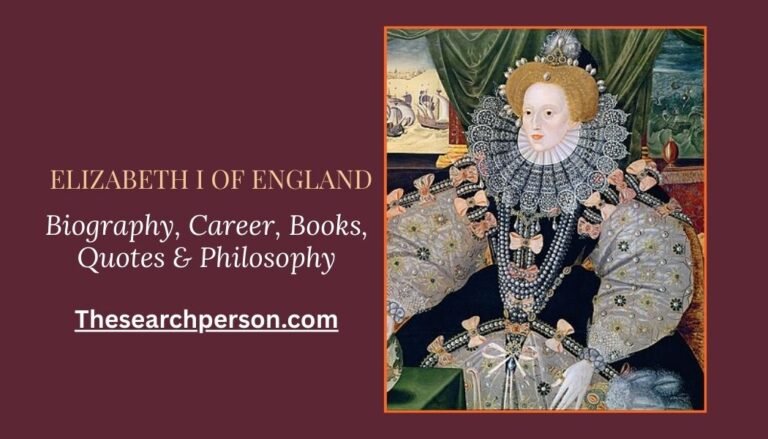
Elizabeth I of England remains one of the most iconic monarchs in world history — a queen renowned for her intellect, political acumen, invincible spirit, and cultural impact. Her reign marked the apex of the English Renaissance, the strengthening of England’s global presence, and the beginning of an era that would shape literature, exploration, religion, and monarchy for centuries. From her complicated childhood to her authoritative rule as the “Virgin Queen,” Elizabeth I carved a legacy that transcends time.
Biography of Elizabeth I of England
Elizabeth I was born on 7 September 1533 at Greenwich Palace to King Henry VIII and Anne Boleyn, his second wife. Her birth was a political earthquake — Henry VIII had split England from the Roman Catholic Church in his quest to have a legitimate male heir, and Anne was at the heart of this religious schism. Elizabeth’s arrival as a girl disappointed many, but fate would prove that a queen could wield power more effectively than most kings.
Table of Contents
Early Childhood
Elizabeth’s early years were turbulent. At the age of two, her mother, Anne Boleyn, was executed on charges of treason and adultery. Elizabeth was declared illegitimate and removed from the line of succession. She was raised in various royal households, receiving an exceptional humanist education built on languages, literature, history, rhetoric, and philosophy. She mastered Latin, Greek, French, and Italian — a testament to her sharp intellectual prowess.
Quick Info
| Section | Details |
|---|---|
| Biography | Born 7 September 1533, daughter of Henry VIII and Anne Boleyn; became queen in 1558; ruled until 1603. |
| Physical Stats / Appearance | Red-gold hair, pale skin, brown eyes; 5’4”–5’6” estimated; known for elaborate gowns and iconic ruffs. |
| Career & Achievements | Defeated Spanish Armada, established Anglican Church identity, expanded exploration, patron of arts & literature. |
| Family & Siblings | Father: Henry VIII; Mother: Anne Boleyn; Siblings: Edward VI, Mary I. |
| Relationships | Never married; close relationships with Robert Dudley and Earl of Essex. |
| Books & Writings | Translations from Latin/Greek; speeches like “Tilbury Speech” and “Golden Speech.” |
| Philosophy | Moderate Protestantism, political pragmatism, self-reliance, devotion to national unity. |
| Quotes | “I have the body of a weak woman but the heart and stomach of a king.” |
| Death | Died 24 March 1603; likely natural causes related to age. |
| Legacy | Elizabethan Era, English Renaissance, naval expansion, cultural golden age. |
Elizabeth I’s Siblings
Elizabeth grew up with several half-siblings:
- Mary Tudor (Mary I), daughter of Catherine of Aragon
- Edward VI, son of Jane Seymour
- Henry VIII had other children rumored or acknowledged informally, but Mary, Edward, and Elizabeth were his legitimate heirs.
Among them, Mary and Elizabeth had a particularly complicated relationship shaped by religious and political differences. Edward VI, a devout Protestant, supported Elizabeth’s learning and future prospects. After his early death, Mary I ascended the throne.
Religion, Imprisonment & Rise to Power
Mary I, a strict Catholic, viewed Elizabeth with suspicion due to her Protestant beliefs and her popularity with the English people. Elizabeth was eventually imprisoned in the Tower of London after being accused of supporting Protestant rebels.
Though she was later released, her freedom remained restricted until Mary I’s death in 1558. With no legitimate heirs alive, Elizabeth ascended the throne at the age of 25, becoming Queen Elizabeth I of England.
Her coronation on 15 January 1559 marked the beginning of an illustrious reign often referred to as the Elizabethan Era.
Physical Appearance – What Did Queen Elizabeth I Really Look Like?
Historical accounts describe Elizabeth as tall, slender, and graceful. Her “real face”, before smallpox scars and heavy makeup concealed her features, displayed:
- Pale complexion
- Striking reddish-gold hair
- Sharp, intelligent eyes
- A commanding yet charismatic presence
Portraits from early in her reign show a lively, vibrant queen, whereas later images reflect her iconic painted appearance: porcelain skin, towering wigs, elaborate ruffs, and jewels symbolizing majesty.
Career Highlights – What Did Queen Elizabeth I Do for Her Country?
Elizabeth I’s rule transformed England in multiple spheres — political, economic, cultural, and religious. Her policies stabilized the nation, strengthened its independence, and set the stage for global influence.
The Elizabethan Religious Settlement
Elizabeth inherited a kingdom torn by religious conflict. She introduced the Elizabethan Religious Settlement (1559), reinstating Protestantism while retaining some Catholic traditions to avoid unrest. This compromise defined Anglicanism and shaped English spiritual identity for centuries.
Defeat of the Spanish Armada (1588)
Perhaps the most defining military event of her reign was the defeat of the Spanish Armada. Spain, then the most powerful empire in the world, sought to dethrone Elizabeth and restore Catholic dominance. Against overwhelming odds, England triumphed — a victory symbolizing Elizabeth’s strategic brilliance. It also cemented England as a rising naval power.
Patronage of the Arts
Elizabeth’s era was a golden age of English culture. She supported writers, poets, musicians, and scholars. Her reign nurtured the talents of:
- William Shakespeare
- Christopher Marlowe
- Edmund Spenser
The English Renaissance flourished, producing works that still shape global literature.
Global Exploration
Elizabeth supported explorers such as:
- Sir Francis Drake
- Sir Walter Raleigh
- John Hawkins
Their voyages initiated England’s expansion into the New World, establishing early foundations for future empire.
Political Stability
After decades of turmoil under previous reigns, Elizabeth maintained comparative peace and prosperity. Her diplomacy balanced threats from France and Spain while keeping internal dissent at bay.
Books, Writing & Education
Elizabeth was not just a reader — she was an accomplished writer, translator, and thinker. She translated multiple works from Latin and Greek and penned speeches, prayers, and political treatises.
Notable texts associated with her include:
- The Golden Speech (1601)
- The Tilbury Speech (1588)
- Translations of works by Cicero, Seneca, and Marguerite de Navarre
Her educational background formed the foundation of her precise rhetoric and clear political philosophy.
Elizabeth I’s Philosophy, Values & Quotes
Elizabeth’s worldview was shaped by:
- Pragmatism
- Political caution
- Personal independence
- Religious moderation
- Devotion to national unity
Her famous quotes reflect this:
1. On Marriage
“I have already joined myself in marriage to a husband, namely the kingdom of England.”
2. On Leadership
“I know I have the body of a weak, feeble woman; but I have the heart and stomach of a king.”
3. On Public Duty
“To be a king and wear a crown is more glorious to them that see it than it is pleasant to them that bear it.”
4. On Trust
“There is no marvel in a woman learning to speak, but there would be in teaching her to hold her tongue.”
These lines illustrate her strength, wit, and astute understanding of power.
Personal Life, Love & Relationships
Elizabeth I never married, earning the title “The Virgin Queen.”
Rumored partners and close relationships included:
- Robert Dudley, Earl of Leicester
- Robert Devereux, Earl of Essex
- Foreign suitors like King Philip II of Spain & the Duke of Anjou
However, she carefully avoided marriage to preserve political neutrality and independence. She feared that marrying a foreign prince would threaten England’s sovereignty. Likewise, marrying an English noble could shift the balance of power within her court.
Her choice not to marry remains one of her most strategic political decisions.
How Did Queen Elizabeth I Die?
Elizabeth I died on 24 March 1603 at the age of 69. Her cause of death is widely debated. The most accepted explanations include:
- Natural causes from old age
- Possible blood poisoning
- Chronic depression and physical decline
- Pneumonia or throat infection
Witnesses recalled that she refused to lie down for several days before dying, believing that reclining would make her appear weak. She finally passed away at Richmond Palace.
Upon her death, the Tudor dynasty ended. She was succeeded by James VI of Scotland, who became James I of England, uniting the crowns.
Legacy of Elizabeth I
Elizabeth I’s influence continues to this day:
- She stabilized England after decades of religious conflict.
- She elevated English arts, literature, and theatre.
- She encouraged naval expansion and exploration.
- She formed a national identity rooted in Protestantism, English culture, and maritime strength.
- She shaped monarchy into a diplomatic, symbolic institution.
Her reign — the Elizabethan Era — is still celebrated as one of history’s most brilliant epochs.
10 Facts About Queen Elizabeth I
- She spoke at least six languages fluently.
- She survived imprisonment in the Tower of London.
- She became queen at age 25.
- Her reign lasted 45 years.
- She never married or had children.
- She encouraged Shakespeare and many Renaissance writers.
- She survived multiple assassination plots.
- She defeated the Spanish Armada.
- She popularized fashion trends like white lead makeup and giant ruffs.
- She was the last Tudor monarch.
More Info About TheSearchPerson


